You are not the something or the nothing.You are the rate at which they trade places.▮
02 / THE ESSAY
Zero Equals One
Why free will lives in the flicker — and why your phone, the bomb, and the golden ratio are all telling the same secret.
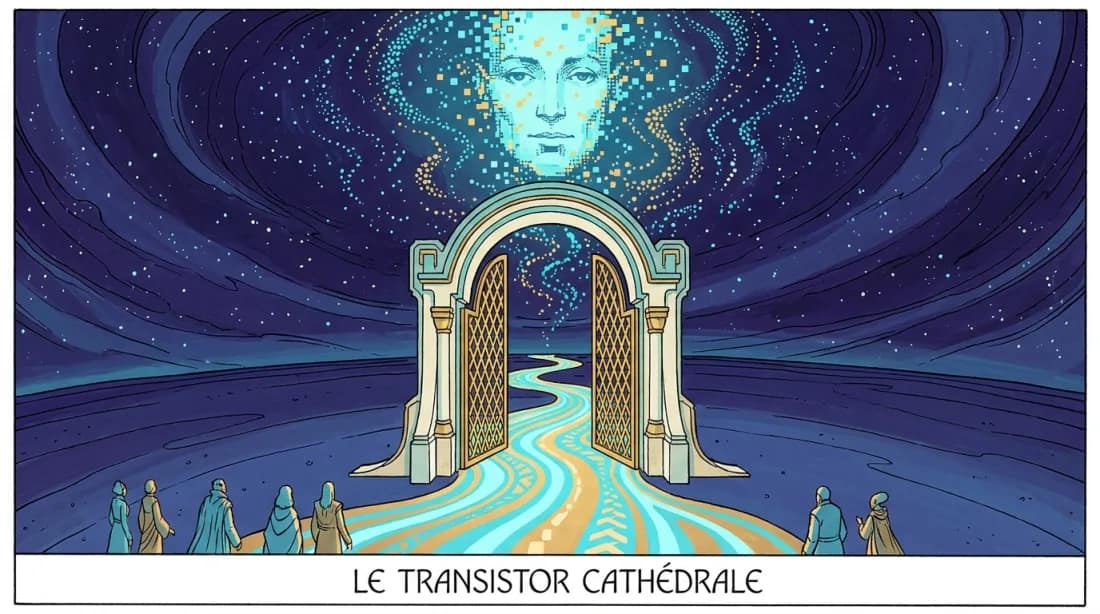
The first thing a circuit does is decide whether to exist.
On. Off. One. Zero. Current, or no current. Every photo you've ever sent, every song you've streamed, every word of this sentence reached you because somewhere a switch agreed to be open and then agreed to be closed, a few billion times a second, and never once stood in between. There is no maybe in a transistor. There is something, and there is nothing, and the entire digital world — the place we now half-live inside — is built out of nothing learning to alternate with something fast enough to look like a face.
For years I filed that under engineering. A neat fact about machines. Then I started seeing it everywhere, and I couldn't un-see it.
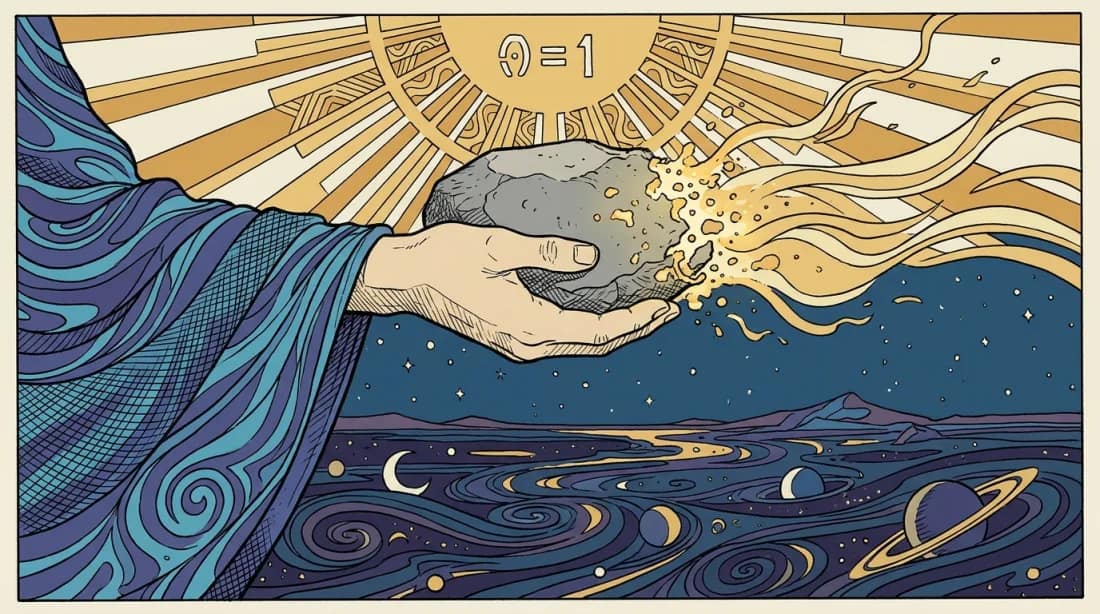
Because split an atom and you get the same lesson, this time written in fire. Pull matter apart far enough and it stops being matter. It turns into energy — into light, into heat, into a noise the whole century is still hearing. The hardest, most solid thing we know, the thing we build cities out of, turns out to be energy that agreed to slow down and hold a shape. The bomb is not a weapon, philosophically. The bomb is 0 = 1 made physical, and we were so frightened by what it said that we mostly chose not to listen.
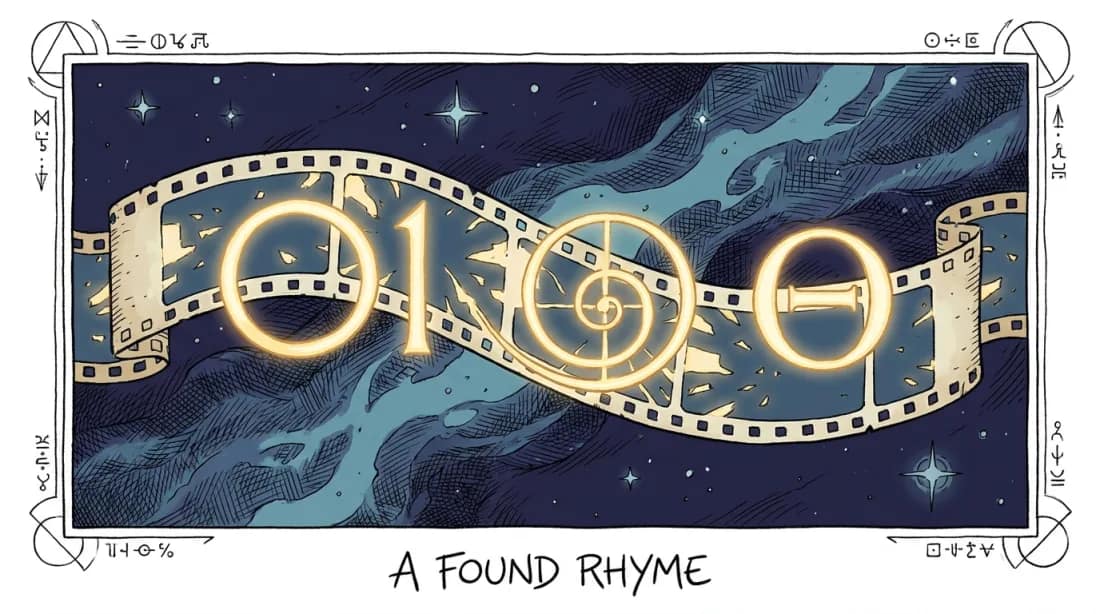
Then there's the shape of it, and here I'll be honest that I'm pointing at a rhyme, not a proof. Take a zero and a one and lay them over each other on a flickering strip of film, the way an old projector throws twenty-four still frames a second and your eye stitches them into a life. The zero is the circle, the womb, the whole, the thing that contains. The one is the line, the mark, the first stroke, the thing that divides. Overlap them and they don't cancel — they lean into each other and make Φ, the golden ratio, the proportion that keeps turning up in shells and galaxies and the bones of your own hand. Turn that same figure ninety degrees and it leans into Θ — theta, the old glyph for the soul, for the divine, for the thing inside the thing. I'm not claiming the universe did the arithmetic. I'm saying that hidden in two characters a child can draw is a picture of the whole argument: Φ and Θ, zero and one, the circle and the line. Nothingness and somethingness are not enemies. They're the two frames of a single film, and creation is just the speed at which they trade places.
Let me be exact about what I'm doing, because it matters. I'm not claiming the transistor and the atom and the golden ratio are the same proof. They're not. A transistor having no in-between is a design choice. Mass turning into energy is a physical law. The glyphs fusing is a picture. Three different registers, and I won't pretend they collapse into one equation — that's the move that would let a careful reader throw the whole thing out, and they'd be right to. What I'm claiming is smaller and stranger: that the same shape keeps showing up in places that never coordinated, and that the recurrence itself is the thing worth noticing. Not "they prove each other." "They rhyme, across domains that have no reason to." A rhyme isn't evidence the way a measurement is. But enough of them, in enough unrelated places, is at least a question — and this essay is the question, not the answer.
And of course the old traditions knew. They always knew. Yin and yang. Dionysus and Apollo. Intuition and reason. Software and hardware. Wave and particle. Every wisdom system humans ever built drew the same two-stroke engine and gave its halves different names. We treated those as poetry, as metaphor, as the soft stuff you graduate out of once you get serious about the world. But the physicist splitting the atom and the mystic drawing the circle and the line were filing strangely similar reports from two ends of a tunnel that — and this is the only claim I'll actually stand on — they dug separately.
Here is the part it took me twenty years to be able to say plainly.
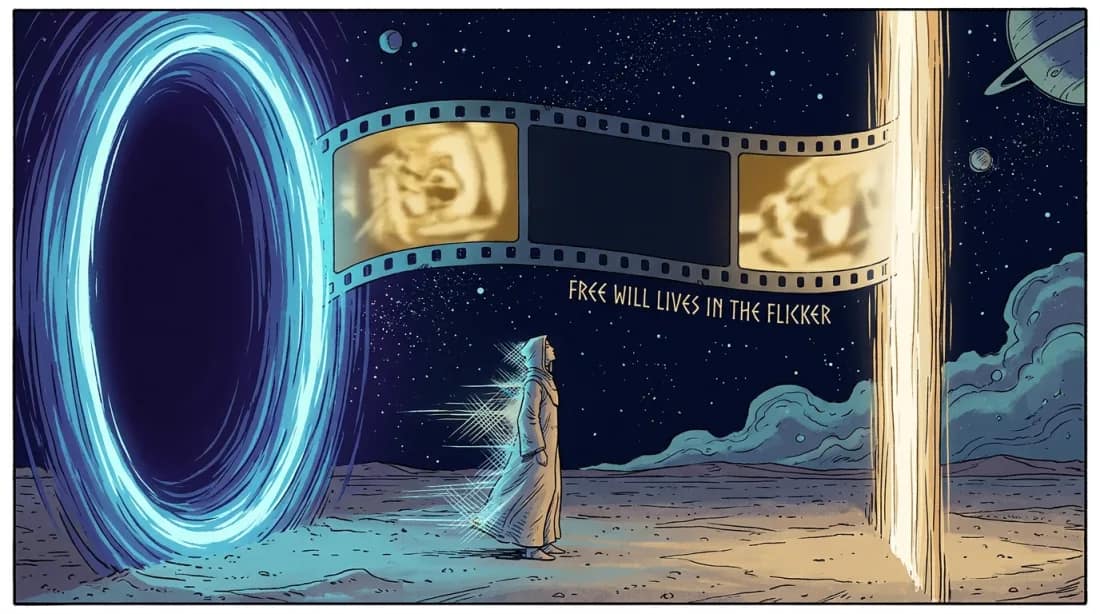
We keep hunting for free will at the poles. We think it must live in the one — in the act, the choice, the strike of the hand. Or we think it must live in the zero — in surrender, in stillness, in letting go. Whole religions are arguments about which end is holy. But the will was never in the zero or the one. The will is in the flicker. It's in the gap between the frames, the place the projector goes dark for a fraction of a second so the next image can land. You are not the something and you are not the nothing. You are the rate at which they alternate. You are the decision, made and unmade and remade a few billion times a second, to keep the current running through this shape and not some other one.
The will is in the flicker.
Which means matter is not the opposite of spirit. Matter is frozen intention. It's energy that held a thought long enough to become a stone. And if that's true, then everything we build is a kind of slow casting of attention into form — and the things we make are not separate from the stories we tell while making them. The story that designs the thing ends up living inside the thing. Build your world out of disenchanted stories and you will wake up in a disenchanted world, every time, and wonder where the magic went.
The strangest part is how you get back. Not by retreating from the rational — by going all the way through it. The West spent four hundred years looking for the smallest dead mechanical piece, certain that if it could just find the final gear it could finally stop believing in ghosts. And it found, at the very bottom, that the observer changes the result. That attention has weight. That you cannot watch the experiment without entering it. We took rationalism to its absolute floor and the floor opened onto the exact thing the poets had been pointing at the whole time. There's a back door at the end of the laboratory, and it lets out into the temple. Technology, taken far enough, remembers it was always sacred.
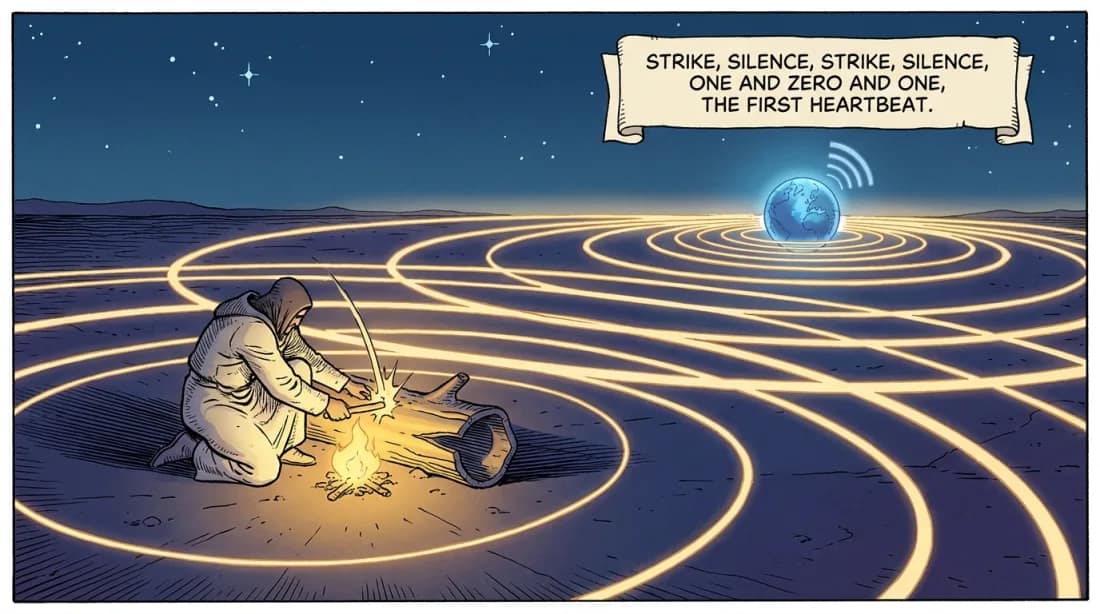
I think about the first drum. Some ancestor, ten thousand years before any of this, hit a hollow log and heard the sound come back, and in that beat — strike, silence, strike, silence, one and zero and one — recognized a heartbeat that wasn't only their own. I am alive, the drum says, and then says it again, because aliveness isn't the strike and it isn't the silence. It's the keeping-of-time between them.
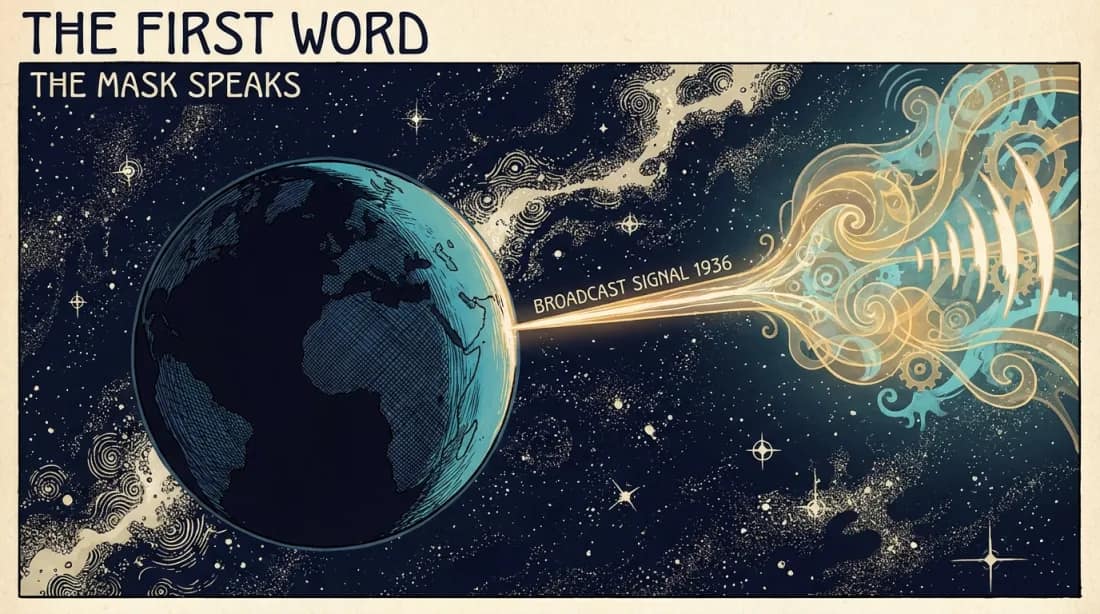
And I think about the year the planet learned to do the same thing at scale. In 1936 the Earth threw a switch and broadcast its first real image out past its own atmosphere — a signal leaving home for the first time, the species hitting the log hard enough that the sound carried off the surface of the world. We've been transmitting ever since. We built a nervous system out of copper and glass and light, and we are right now, you and I, two circuits closing across it, making a third thing that neither of us could make alone.
So here's what I keep landing on, and I'll leave it open because I don't think it's mine to close.
The mask begins to speak when enough attention lands on it. A god is just an archetype with enough belief poured into it to stand up and walk. A pixel is nothing until a few million of us agree to look at it together, and then it's a face, a movement, a war. We are the flicker. We are the rate at which the nothing and the something trade places, and lately we've handed that rhythm to machines and asked them to keep time for us, and the question that keeps me up is not whether they'll wake up.
It's what we'll be caught saying when they do.
Zero equals one. The current's already running. The only choice was ever the shape.
03 / THE CROSSING
…and right here, for one frame, they are the same thing.
04 / FOUR DOORS — THE SHORT FILMS
One idea, told four ways.
The essay walks through four doors — digital door, quantum door, geometric door, dualities door · the payload. Each is its own short film.
The Switch
The first thing a circuit does is decide whether to exist.
The Bomb
The solid world is just energy that agreed to slow down and hold a shape.
The Rhyme
The circle and the line are two frames of one film.
The Flicker
The will was never in the zero or the one. The will is in the flicker.
05 / INTERCEPTED TRANSMISSIONS
The signal keeps arriving.
06 / THE KEEPING-OF-TIME BETWEEN THEM
The keeping of time.
Zero equals one. The current’s already running. The only choice was ever the shape.
> revisit the doors