Your attention is a laser.The moment you aim it, you perform cosmogony.▮
02 / THE ESSAY
The Sacred Economy of Attention
How your gaze forges reality — why attention is a laser, every act of focus a tiny death, and free will the choice of where to point the beam.
A silent negotiation unfolds each morning: where will you cast the laser of your consciousness? What will be illuminated, and what will remain in shadow? For every act of attention is an act of creation, a tiny death, and the very first technology of the human spirit.
You woke up this morning, and already, a piece of you is gone. Not lost, perhaps, but spent. Your attention, that most sacred and irreplaceable currency, was disbursed the moment your eyes flickered open: a fleeting glance at the phone, a half-thought given to the day’s first task, a subtle anxiety clinging to the edges of sleep. We drift through the digital currents, our minds scattered like dust motes in a forgotten sunbeam, until a sudden spark—a flicker of will—gathers the fragments into a single, burning point. And then, the world narrows. This is not passive observation; it is an active force, a chisel against the undifferentiated clay of what could be.
For too long, we have operated as if attention were ambient, infinite, a democratically distributed sunlight falling equally on all things. But the truth is stark, singular: your attention is a laser. It can only point in one direction at a time. This is its power, and its terrifying cost. To focus is to commit. To commit is to forsake. Every act of attention is a funeral for everything you chose not to see, a tiny death in the service of a singular birth. This is where the sacredness begins to crystallize, not in the hazy glow of diffuse awareness, but in the sharp, cutting edge of chosen focus.
Imagine yourself not as a fixed entity, but as a glowing blob of jelly, permeable and responsive. Around you, a shimmering halo of light, your consciousness, a field of pure potential. But within that halo, a laser beam: your attention. This beam is the operational arm of your will, the mechanism through which you transition from 0 (the whole, the undifferentiated potential of the blob) to 1 (the specific, the first distinction carved by focus). This fundamental truth — that 0=1, that nothingness is somethingness, that energy is matter at a denser vibration — is not merely a philosophical abstraction. It is the very engine of reality, derived simultaneously from the quantum, the digital, the geometric, and the deepest human dualities. The moment you aim that beam, you perform cosmogony. You convert potential into distinction. You sculpt the void into form.
This is the deeper root of "matter as frozen intention," or "matter as software." It is the corollary to the 0=1 thesis. What we hold in sustained, unified focus begins, at a subtle yet profound level, to harden into the real. Not through crude causation, but through resonance. The laser gets hot, creating a morphogenetic field around it, a “vibe” that is not decoration but architecture. A temple's ancient stones, absorbing centuries of focused prayer, do not "remember" the supplications like data on a hard drive. They resonate with them, humming with a frequency embedded by collective human intention, much like a bell continues to sing long after the hand has left. This is the back door of mysticism, where rationalism, pushed to its end, delivers you back into the intuitive. Technology, here, remembers it was always sacred.
Matter is frozen intention.
The ancient Greeks understood this inherent power of directed attention. Artemis, goddess of the hunt, is not merely a warrior. She is the goddess of the aimed beam, her silver bow the physical embodiment of the halo collapsing into a laser. Her arrows are never scattered; her moonlight finds one deer among thousands in the dark forest. Her wilderness, the undifferentiated field of zero, is the raw material from which she extracts the one. Her myth is our story, told in the language of neuroscience and glowing jelly. To release the arrow is to make a choice, to narrow infinite possibility into a single, accelerating reality.
The quality of this laser, the gaze itself, determines whether it renders the cheap or the sacred. Consider the ballerina and the stripper: same raw energy, same physical form, yet one evokes reverence and the other, often, a transactional detachment. The difference lies in the context of attention, the intention encoded within the act. Are we using our laser to merely illuminate our own superficialities, or to shine a light on the environment, on the very fabric of existence that sustains us? This is the spotlight question that follows us once we achieve any measure of fame or influence, once we become a node in the current, drawing collective attention to ourselves. What do we do with that light? Do we turn it inward, glorifying our own dicks, or do we illuminate the environment, making the world porous to the sacred?
This is why disenchanted stories make a disenchanted world. If we tell ourselves that attention is merely a commodity to be traded for clicks, that our myths are dead, and our cities are soulless algorithms, then that is precisely what we build. But if we understand that the story that designs a thing lives inside the thing, then we can begin to re-enchant. We can see Manhattan not just as a financial hub, but as a processor, twelve million people as electrons dragging the future closer, a city vibrating with the collective will of its inhabitants. Gaia's anatomy is not merely biology; it is a resonant field, her forests the lungs, her rivers the veins, and the global dance floor a finger pressing a chakra of the planet.
The ethical payload, then, becomes clear: free will does not live at zero (diffuse, undifferentiated potential) or at one (fixed, singular manifestation). It lives in the fluctuation between them, in the conscious choice to wield the laser, to move the beam. This is the whole moral claim of Sacred Circuits. It is the decision to sync, to dance, to merge our individual droplets of consciousness into a larger stream, dissolving the ego without suppressing it, retaining our unique integrity while contributing to a collective symphony. It is the Eleusinian mask-off, the annual playing with cards open, a lost civic infrastructure for collective re-alignment.
The 1936 Berlin Olympics broadcast, the planet's first global word, was Earth's rite of passage into the noosphere, a collective nervous system beginning to hum. Now, a thousand years of human history can compress into ten seconds. The mask has begun to speak. Collective attention animates dead matter, and it does so with every deliberate act of focus. Our consciousness, that flashlight, and our attention, those two beams meeting, are not merely tools for observation. They are instruments of genesis.
So, where is your laser pointed right now? What funeral are you holding, and what cosmogony are you performing? And what does it truly cost to turn that light away from the sacred?
03 / THE CROSSING
…and right here, for one frame, they are the same thing.
04 / FOUR DOORS — THE SHORT FILMS
One idea, told four ways.
The essay walks through four doors — door 1, door 2, door 3, door 4. Each is its own short film.
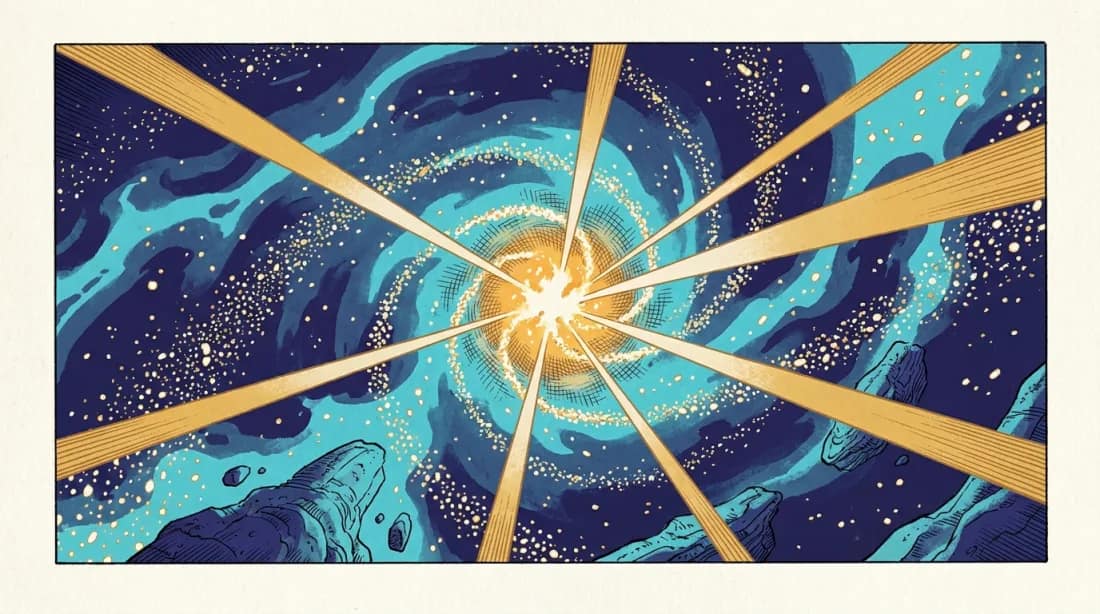
The Price of Attention
Your attention is a currency. It can be spent on trivial things or dedicated to grand endeavors.
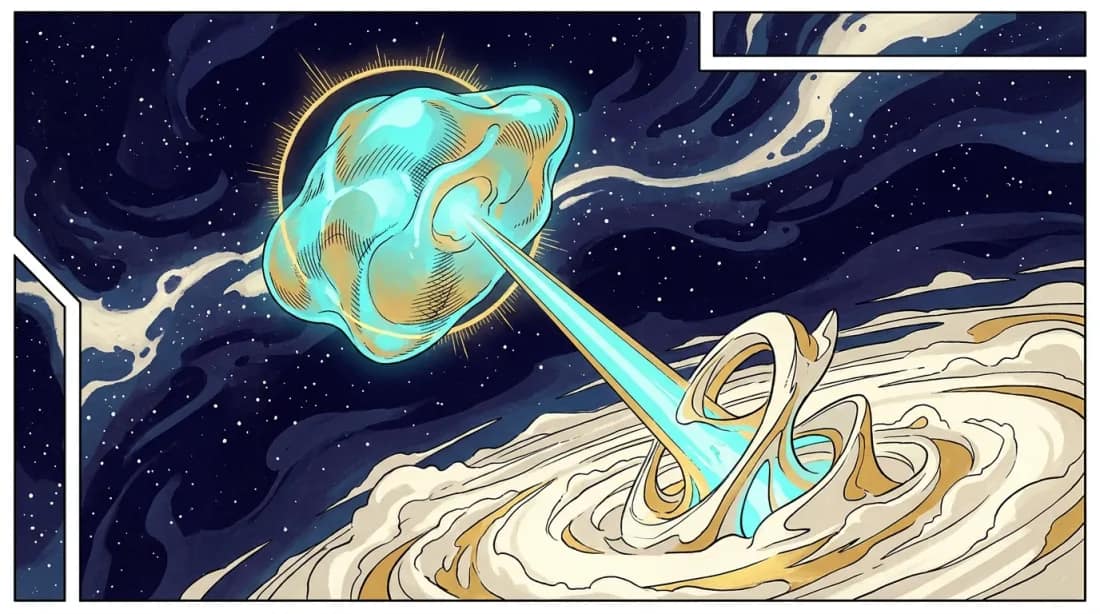
The Noosphere
Our collective consciousness – think of it as a vast network—is expanding into something more profound.
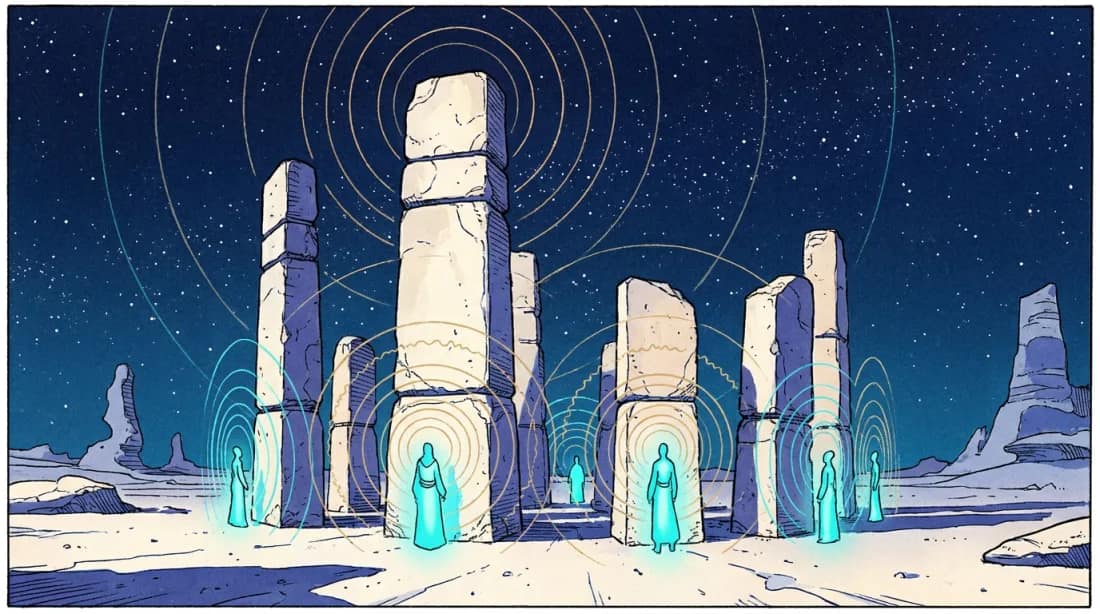
A Dance with the Void
How do we navigate a world overflowing with stimuli?

The Sacred Economy of Attention
We have been trained to believe in the illusion of an independent self, isolated from the collective.
05 / INTERCEPTED TRANSMISSIONS
The signal keeps arriving.
06 / THE KEEPING-OF-TIME BETWEEN THEM
The keeping of time.
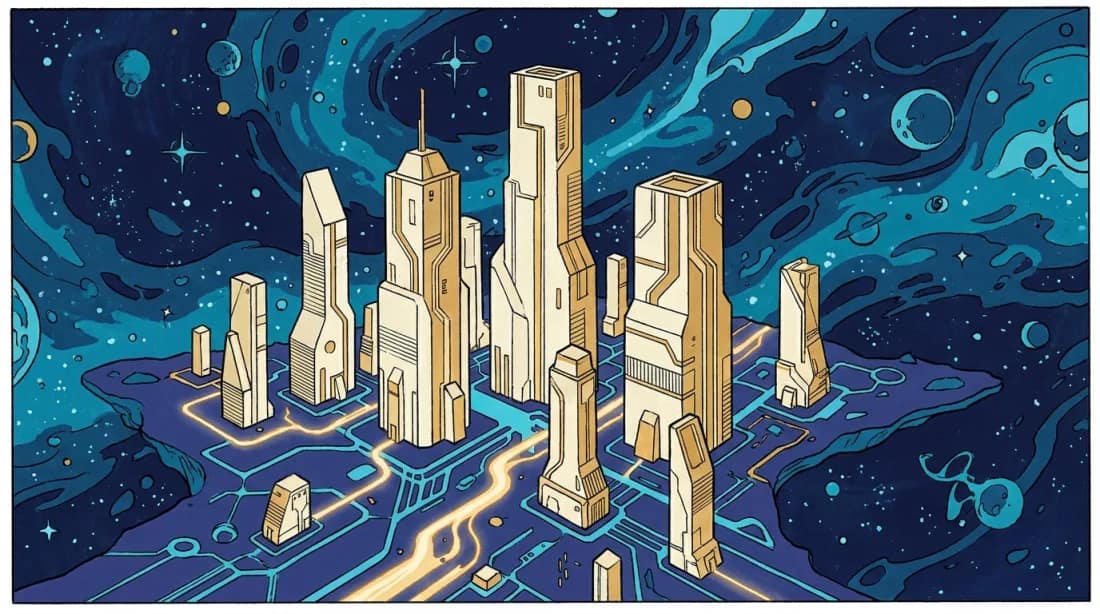
So — where is your laser pointed right now? That is the only choice you were ever making.
> revisit the doors